
Our Suggested Referral Timeline
The exact timeline — and the words — for following up without the pressure
A new inquiry or referral is a person at a hard moment who decided to trust you with it. How you respond, and how quickly, is some of the most important marketing you'll ever do. Here's a simple, humane cadence you can use every time, with language you're welcome to borrow.
A quick note before the timeline: the goal here is never to chase someone down. It's to be reachable, reassuring, and easy to say yes to — and then to step back and let them come to you. Speed early, space after. That's the whole rhythm.
Within a few hours: the first reply
Respond the same business day if you possibly can, and within a few hours if the message arrives during your working hours. This isn't about being instant for its own sake. Someone who reached out at 11 p.m., heart pounding, and hears back warmly the next morning has just learned something about what working with you will feel like.
Keep this first message short. Acknowledge them as a person, thank them, name one clear and easy next step, and take all the pressure off.
Hi [Name],
Thank you for reaching out — I know taking this step isn't easy, and I'm really glad you did.
I'd be glad to help. Whenever you're ready, you can grab a time that works for you here: [booking link]. Or just reply to this email with any questions and we'll go from there.
There's no rush on my end. Reach out when the timing feels right for you.
Warmly, [Your name]
That's it. Resist the urge to oversell or to pile on logistics. The first message earns trust; the details can come once they've said yes.
Around day 3: a gentle nudge
If you haven't heard back in about three days, send one light follow-up. People in this stage get pulled in a dozen directions, and your note almost certainly got buried, not ignored. Make it easy to pick back up, and make sure it carries zero guilt.
Hi [Name],
Just floating this back to the top of your inbox in case it slipped by — I know there's a lot on your plate right now.
No pressure at all. Whenever you're ready, I'm here, and here's that link again if it's helpful: [booking link].
Warmly, [Your name]
One follow-up at this stage is plenty. Resending the same day, or sending three in a week, undoes exactly the calm you're trying to convey.
Around day 10–14: leave the door open
If there's still no reply after another week or so, send a final, warm note — and then genuinely let it go. This message should make it clear you're not going to keep checking in, while leaving the door wide open for whenever the time is right.
Hi [Name],
I won't keep landing in your inbox — I know your plate is full.
I'll leave this here so it's easy to find whenever the moment is right for you. And in the meantime, [a helpful free resource or guide] might be useful, no strings attached.
Wishing you well, truly. [Your name]
After this, the active outreach ends. No drip sequence, no "last chance," no countdown. Letting go gracefully is part of the trust you're building — and people remember the professional who didn't pressure them far more than the one who did.
But ending the chase doesn't mean disappearing. There's a difference between following up and staying in touch, and the second one, done generously, is where a lot of this work quietly pays off.
Then: stay in touch, generously
Once the immediate conversation has run its course, shift gears entirely. Stop trying to move someone toward a yes and start simply being useful to them over time, with no agenda attached. With their consent, keep them in a calm, low-frequency orbit and let value do the work that pressure never could.
The one rule that makes this work: every ongoing touch should give something and ask for nothing. If you only resurface when you want a booking, people feel it. If you resurface because you genuinely thought something would help them, they feel that too — and that's the reputation that brings them back, or sends the next person your way.
A few ways to stay present without ever pushing:
Keep a calm, useful newsletter and invite people to join it, with their consent. Low frequency, high usefulness — practical guidance, honest answers, the occasional resource. Never a sales blast.
Send the genuinely-thought-of-you note, sparingly and specifically. When an article, tool, or resource actually fits someone's situation, pass it along with no ask attached.
Point to a resource, not a calendar. "Here's a guide that might help while you're deciding" lands far better than "ready to book yet?"
Let your content do the touching. Answering common questions publicly keeps you helpful to people who aren't ready to talk yet, and findable the day they are.
Keep your referral relationships warm the same way. Send colleagues useful things, not just thank-yous, so you stay top of mind for the next person they meet.
Here's a no-agenda check-in you might send months later:
Hi [Name],
No agenda here — I came across [resource] and thought of you. It might be useful wherever you are in things right now.
Still here whenever, or never. Either way, wishing you well.
[Your name]
The cadence for this track is slow and generous: weeks or months apart, always offering something. You're not nurturing a lead. You're being a steady, helpful presence in someone's corner — and that's what people remember when the moment finally comes.
Don't forget the person who referred them
If a colleague sent this person your way, close the loop with a quick thank-you. It honors the relationship and keeps the referrals coming — just mind privacy and share only what's appropriate.
Hi [Colleague],
Thank you so much for thinking of me and sending [Name] in my direction. I've reached out and will take good care of them. Grateful for the trust.
[Your name]
The principles underneath the templates
Adapt the words to your voice and your profession — and to any intake or compliance steps your work requires, like conflict checks or scope-of-practice notes. But hold these constant:
Lead with warmth, then logistics. The human comes first; the calendar comes second.
One clear next step per message. Two options at most. A confused reader does nothing.
No urgency, ever. "Whenever you're ready" closes more trust than "spots are limited" — and it's the opposite of how the rest of the industry talks.
Keep it short and plain. People skim when they're overwhelmed.
Don't overpromise. Be honest about what you can and can't do; it's the fastest way to keep the trust you just earned.
Then release the chase — but don't vanish. Three touches, generously spaced; after that, stay in touch slowly and generously, always leading with something useful.
None of this is complicated. It's just steady — reachable in the moment that matters, and respectful enough to step back after. That steadiness is what people remember, and it's exactly the reputation that brings the next referral in.
Being findable when someone's ready to reach out — on their timeline, all year — is what we're quietly building for the experts in our community.
Click to download the checklist!
The Quick-Reference Checklist
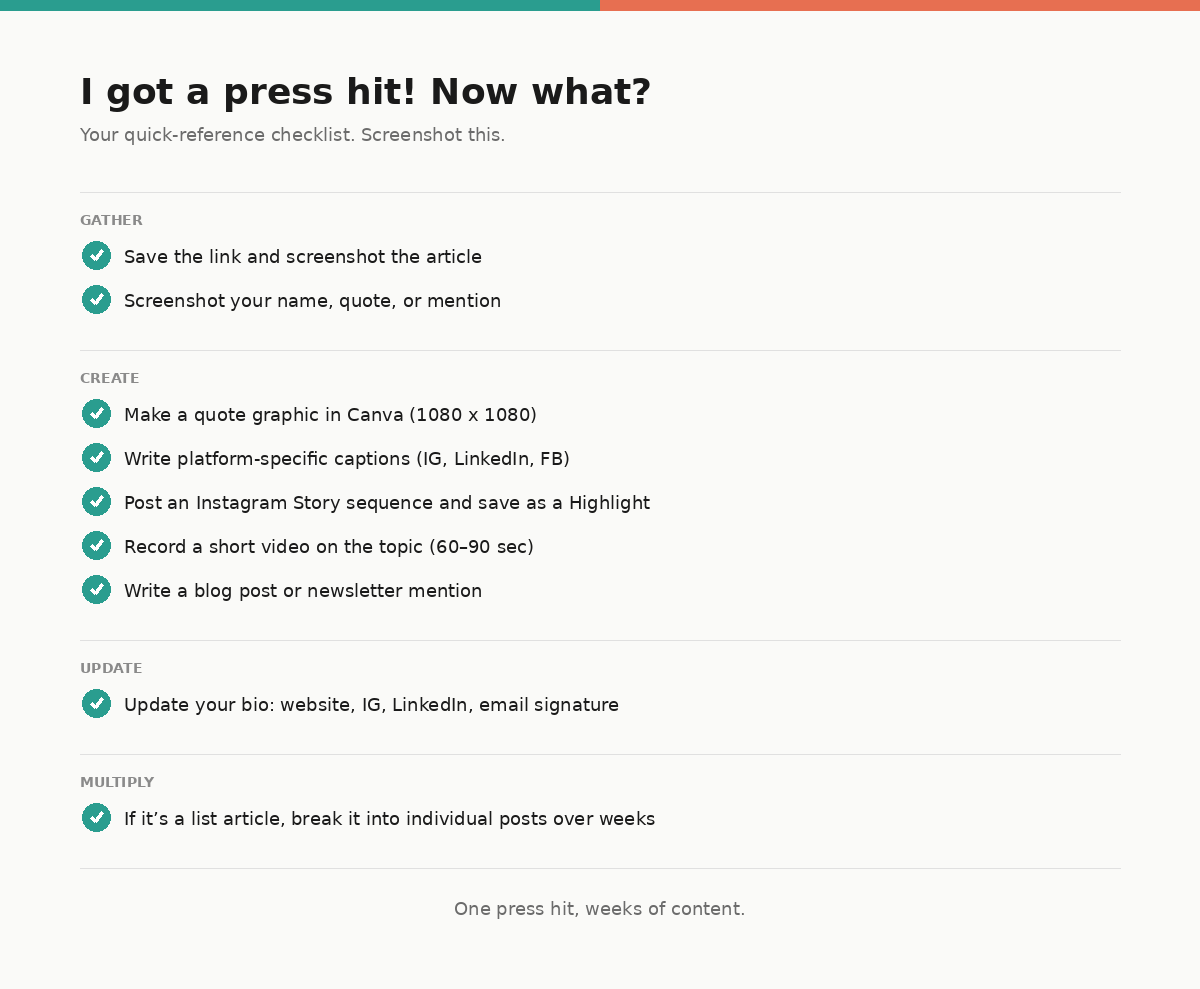
Here's the short version you can screenshot and come back to every time this happens (because it will happen again):
Save the link, screenshot the article, screenshot your quote. Make a quote graphic in Canva. Write three platform-specific social captions. Post an Instagram Story sequence and save it as a Highlight. Update your bio on your website, Instagram, LinkedIn, and email signature. Update any directory profiles. Record a short video on the article's topic. Write a short blog post or newsletter mention. If it's a list article, break it into individual posts and pace them out over weeks.
That's it. One press hit, weeks of content, and a stronger digital footprint that keeps working for you long after the news cycle moves on.